Brief Introduction
In the field of industrial communications, telephones often need to withstand extreme environments such as high temperature, high humidity, strong corrosion, flammability, explosiveness, and human sabotage. Therefore, the choice of casing material is not only crucial for the equipment’s durability but also serves as the first line of defense for safety.
Safecom, a leading global expert in industrial communication equipment, will guide you through an in-depth look at the “four types of armor” used in mainstream industrial telephones and their optimal application scenarios in this article.
Industrial Telephone Material Analysis
- Stainless Steel: The Resilient “All-Round Warrior”
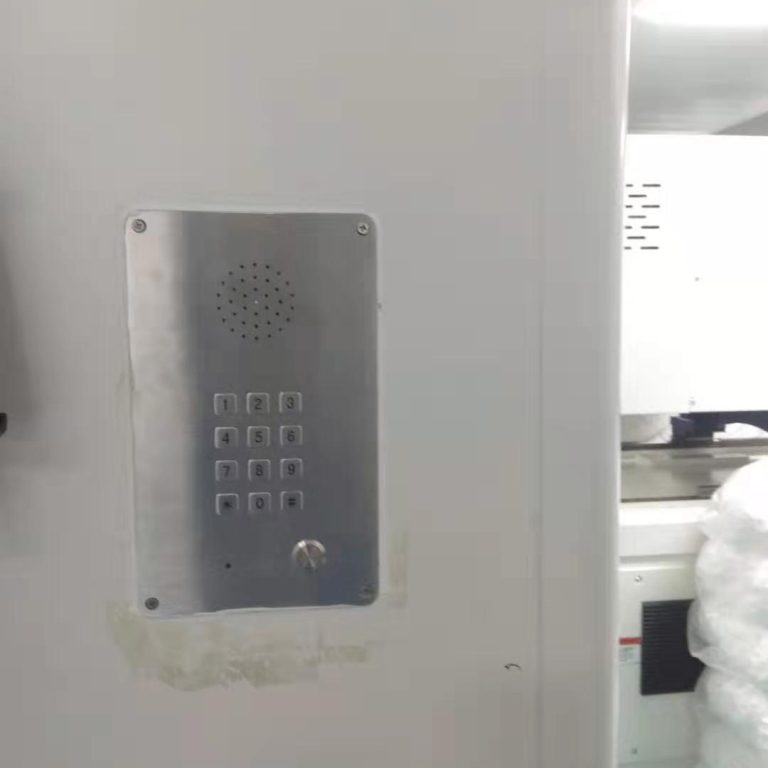
Stainless steel (commonly SUS304 or SUS316) is a high-end component in industrial telephones. It is renowned for its extremely high hardness and excellent oxidation resistance.
Core Characteristics: Extremely strong corrosion resistance, resistance to mechanical impact (resistant to vandalism), easy to clean.
Technical Details: SUS316 material, due to the addition of molybdenum, is superior to 304 in resistance to chloride corrosion (such as sea salt).
Applicable Scenarios:
Food Processing Plants: Resistant to washing and meets hygiene standards.
Coastal Ports/Drilling Platforms: Resistant to salt spray corrosion.
Prisons/Underground Passages: Protected against vandalism, robust and secure.
Click here to learn more about stainless steel industrial telephone products.

- Aluminum Alloy: Lightweight “Explosion-Proof Pioneer”
Aluminum alloy casings are typically manufactured using pressure casting and then electrostatically powder-coated. It is the most commonly used material for explosion-proof telephones.
Core Characteristics: Excellent heat dissipation, lightweight yet high strength, and non-sparking (non-friction ignition material).
Technical Details: Aluminum alloy is less prone to generating mechanical sparks upon impact, which is crucial in flammable and explosive gas environments.
Applicable Scenarios:
Petrochemical/Gas Stations: Areas requiring Ex d level explosion-proof certification.
Underground Mines: Reduces the burden of mobile installation while withstanding severe mechanical impacts.
Click here to learn more about aluminum alloy industrial telephone products.

- Cold-rolled Steel: A Cost-Effective Choice
Cold-rolled steel is currently the most widely used economical material, typically combined with a thick outdoor powder coating.
Core Characteristics: Sturdy structure, good processing performance, and excellent cost control.
Technical Details: Its corrosion resistance is highly dependent on the surface coating process; once the coating is damaged, the risk of rust must be considered.
Applicable Scenarios:
Urban Rail Transit/Tunnels: Large-scale installation, high cost-effectiveness.
Power Cable Trays: Standard industrial deployment in indoor or semi-indoor environments.
Click here to learn more about cold-rolled steel telephone products.

- GRP/Glass Reinforced Plastic: A Special “Insulation Expert”
GRP is a glass fiber reinforced plastic, composed of unsaturated resin and glass fiber.
Core Characteristics: Excellent insulation, resistance to chemical acids and alkalis, rust-free, and extremely lightweight.
Technical Details: In environments with strong electromagnetic interference or high voltage, non-metallic materials possess natural advantages in signal penetration and electrical safety.
Applicable Scenarios:
Chemical Plants/Pickling Workshops: Highly corrosive acid and alkali environments where metal casings are difficult to withstand.
High-Voltage Power Rooms: Prevents the risk of electric shock caused by induced current.
Click here to learn more about glass fiber telephone products.