Brief introduction
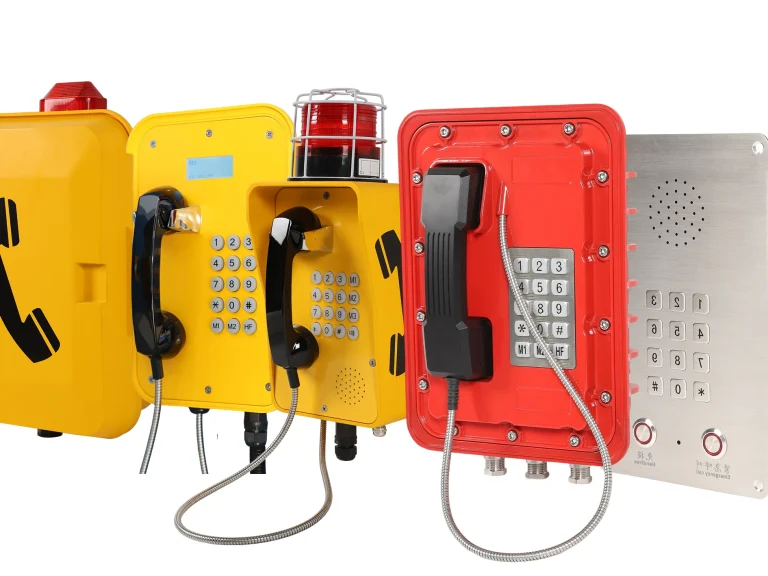
In environments where moisture, dust, and harsh conditions are part of daily operations, choosing the right communication equipment is critical. Waterproof telephones are designed for reliability in such settings, and one of the most important indicators of their durability is the IP protection rating. This article explains the differences between IP protection levels and how they translate into real-world applications, helping users make informed decisions.
What Is an IP Rating?
IP (Protection Rating) is an international standard developed by the International Electrotechnical Commission (IEC). It measures how well an enclosure protects internal components against solid particles and liquids. The rating is expressed as IP followed by two digits, each representing a different type of protection.
The first digit refers to protection against solid objects such as dust.
The second digit indicates resistance to water intrusion.
The higher the number, the stronger the protection.
Solid Particle Protection: The First Digit
For waterproof telephones, dust resistance is often just as important as water resistance, especially in industrial or outdoor environments.
IP5X: Limited dust ingress is permitted, but not enough to interfere with operation. Suitable for semi-outdoor or sheltered industrial areas.
IP6X: Complete protection against dust. This level is essential for mining sites, cement plants, and desert or coastal installations where fine particles are unavoidable.
Most professional waterproof telephones adopt IP6X as a baseline to ensure long-term reliability.
Water Protection Levels: The Second Digit
The second digit is typically the key focus for waterproof communication devices.
IPX4: Protection against splashing water from any direction. Appropriate for indoor locations with occasional moisture.
IPX5: Resistant to low-pressure water jets. Commonly used in wash-down areas or outdoor walls.
IPX6: Withstands strong water jets and heavy rain. Ideal for exposed outdoor installations.
IPX7: Survives temporary immersion in water (usually up to 1 meter for 30 minutes). Suitable for flood-prone environments.
IPX8: Designed for continuous immersion under conditions specified by the manufacturer. Used in extremely demanding environments.
Common IP Ratings and Their Applications in Waterproof Telephones
- IP65 (Dust-tight + Water Jets)
Widely used for outdoor emergency telephones, roadside phones, and factory installations where rain, dust, and cleaning processes are routine. IP66 (Dust-tight + Powerful Water Jets)
Recommended for ports, shipyards, offshore platforms, and heavy industrial sites exposed to storms or high-pressure cleaning.IP67 (Dust-tight + Temporary Immersion)
Suitable for tunnels, underground facilities, and areas where accidental submersion may occur.IP68 (Dust-tight + Continuous Immersion)
Designed for extreme conditions such as coastal infrastructure, water treatment plants, or specialized industrial environments.
Choosing the Right Level of Protection
Not every environment requires the highest IP rating. Over-specification can increase costs unnecessarily, while under-specification can lead to premature failure. The key is matching the IP level to actual environmental risks such as rainfall intensity, cleaning methods, dust concentration, and flooding probability.
A professional waterproof telephone manufacturer should be able to recommend the most suitable IP rating based on your application scenario.